
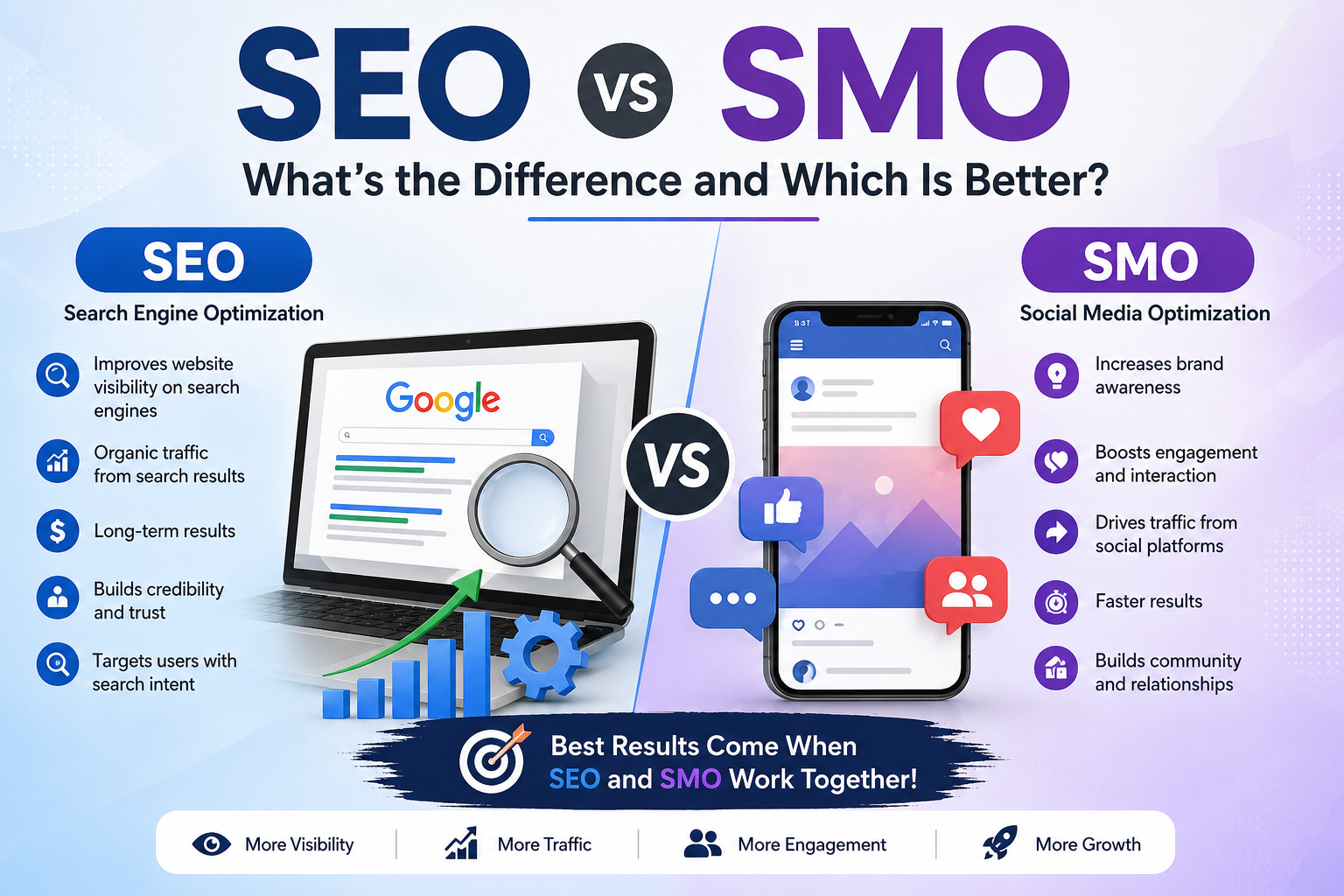
Digital marketing has many strategies that help businesses attract customers, build visibility, and generate leads online. Two commonly used strategies are SEO (Search Engine Optimization) and SMO (Social Media Optimization). Although both aim to increase online visibility, they work through different channels and use different techniques.
If you are a business owner, marketer, student, or digital marketing professional, understanding the difference between SEO and SMO can help you choose the right strategy for your goals.
What Is SEO?
SEO, or Search Engine Optimization, is the process of improving a website and its content so that it can appear higher in search engine results.
Search engines such as Google use various signals to determine which pages should appear for a particular search query. SEO focuses on making a website more useful, relevant, technically sound, and authoritative.
For example, if someone searches for “digital marketing course in Pune,” an SEO-optimized website may appear on the first page of Google if its content and overall website signals are strong enough.
Key SEO Activities
SEO generally includes:
- Keyword research
- On-page optimization
- Technical SEO
- Content creation
- Internal linking
- Website speed optimization
- Mobile optimization
- Image optimization
- Local SEO
- Link building
- Competitor analysis
- Search intent optimization
The main objective is to attract organic traffic from search engines.
What Is SMO?
SMO, or Social Media Optimization, focuses on improving a brand’s presence and visibility on social media platforms.
Instead of primarily targeting search engine users, SMO helps businesses create content that encourages people to discover, interact with, and share their brand through social networks.
Platforms commonly used for social media marketing and optimization include Instagram, Facebook, LinkedIn, YouTube, Pinterest, and other relevant platforms.
For example, a digital marketing institute can create educational reels, student success stories, informative posts, videos, and industry tips to increase engagement and brand awareness.
Key SMO Activities
SMO can include:
- Creating engaging social media content
- Optimizing social media profiles
- Using relevant hashtags
- Creating videos and reels
- Increasing audience engagement
- Encouraging shares and comments
- Creating social media campaigns
- Building online communities
- Maintaining consistent branding
- Promoting website content on social platforms
The primary objective is to increase social visibility, engagement, brand awareness, and website traffic.
SEO vs SMO: Key Differences
Although SEO and SMO are both important digital marketing techniques, there are several differences between them.
| Factor | SEO | SMO |
|---|---|---|
| Full Form | Search Engine Optimization | Social Media Optimization |
| Main Channel | Search engines | Social media platforms |
| Primary Goal | Increase organic search visibility | Increase social visibility and engagement |
| Traffic | Organic search traffic | Social traffic |
| Main Focus | Keywords, content, technical optimization, authority | Content, engagement, sharing, community |
| Results | Often gradual and long-term | Can generate faster engagement |
| Content | Blogs, landing pages, guides, product pages | Posts, reels, videos, stories, graphics |
| Audience Intent | Often actively searching | Often discovering content |
| Measurement | Rankings, organic traffic, conversions | Reach, engagement, shares, followers |
Benefits of SEO
SEO can provide several long-term benefits for a business.
1. Generates Organic Traffic
A well-optimized website can receive visitors from search engines without paying for every individual click.
2. Builds Long-Term Visibility
High-quality content can continue attracting visitors over time, making SEO a valuable long-term marketing strategy.
3. Builds Credibility
Websites that consistently provide useful and relevant information can establish greater credibility with their target audience.
4. Supports Lead Generation
SEO can attract users who are actively searching for a product, service, or solution, which can make search traffic highly valuable.
5. Helps Local Businesses
Local SEO can help businesses improve their visibility when potential customers search for services in a particular location.
Benefits of SMO
SMO also offers important advantages for businesses.
1. Increases Brand Awareness
Social media allows businesses to reach new audiences and introduce their products or services to potential customers.
2. Encourages Engagement
Comments, likes, shares, saves, and direct messages can create two-way communication between brands and customers.
3. Helps Build Communities
Consistent social media activity can help businesses create an audience that regularly interacts with their content.
4. Supports Content Distribution
Businesses can use social media to distribute blogs, videos, case studies, offers, and other content.
5. Provides Customer Insights
Social media engagement can provide valuable feedback about what audiences like, dislike, and want to learn.
SEO vs SMO: Which Is Better?
There is no universal answer to whether SEO or SMO is better. The right choice depends on the business objective.
If your goal is to generate long-term organic traffic and capture users actively searching for your products or services, SEO should be a major priority.
If your goal is to increase brand awareness, engagement, community building, and content reach, SMO can be extremely useful.
For example, a local training institute may use SEO to rank for searches such as “digital marketing course in Pune” while using Instagram and LinkedIn to share student achievements, educational content, videos, and course updates.
Using both strategies together can create a stronger digital marketing ecosystem.
How SEO and SMO Work Together
SEO and SMO should not always be treated as competing strategies. They can support each other.
A business can publish an SEO-focused blog on its website and then promote that blog through social media. Social media can help the content reach a larger audience, while the website continues working to attract organic search traffic.
Similarly, social media can help a brand discover topics that audiences are interested in. Those insights can then be used to create useful website content.
For example:
SEO: Create a detailed article about “Digital Marketing Career Opportunities in 2026.”
SMO: Create Instagram reels, LinkedIn posts, and short videos around the same topic.
Result: The same topic can reach people through both search engines and social media.
Should You Learn SEO or SMO?
If you are planning a career in digital marketing, learning both SEO and SMO is recommended.
SEO can help you understand search engines, keywords, website optimization, content strategy, and organic traffic.
SMO can help you understand social media content, audience engagement, branding, community building, and content distribution.
Together, these skills can give you a broader understanding of digital marketing.
Final Thoughts
SEO vs SMO is not necessarily a competition. Both strategies serve different purposes and can work together to strengthen a business’s online presence.
SEO focuses primarily on search visibility and organic traffic, while SMO focuses on social visibility, engagement, and audience interaction.
For sustainable digital marketing growth, businesses should consider using a combination of SEO, SMO, content marketing, paid advertising, email marketing, and other relevant strategies.
The best approach is to understand your target audience, business objectives, budget, and marketing goals before deciding where to invest your efforts.
In simple terms: SEO helps people find you when they search, while SMO helps people discover, engage with, and share your brand on social media.
